
Battlecard as a Service
One matchup. One battlecard. $90.
Pick your product and theirs. We assemble the card from the graph (products, pricing moves, reviews, and signals) and email it to you when it is ready. Check out as a guest: no account, no sales call.
$90 one-time · rebuild it with tokens whenever you ask, within limits you set
Already bought one? Sign in to your reports
Buy now
Pick a competitor. Buy it once, or keep it current.
3 · Tune the context (optional — the same controls as in the app)
4 · Choose how you want it
One-time
$90
One battlecard, generated from the graph with your context above. Printable PDF (landscape) + web view, emailed to you when it is ready. No account needed.
Kept up to date
With tokens
Rebuild a battlecard whenever you need it. Each rebuild is paid with tokens: you see its estimate first and set the most it may use. Bought tokens never expire, and a reports account is free.
Prices load live from Stripe. Personas, industry, and location come from the same lists the app uses, and your choices shape the card just as they do in the app. Bought as a guest, it arrives by email with a link to keep it in a free reports account.
Tune the card before you buy: personas, customer industry, location, and tone. The preview updates as you change them, so you see the card you pay for.
Keep it current
Keep battlecards up to date with tokens.
Buy tokens once and spend them as you go: a new battlecard, a rebuild whenever you ask for one, or the AI tools on your reports. Prices are live from our checkout.
An estimate before every build
Each battlecard shows about how many tokens it will use before you build it, from what similar builds used.
Limits you set
Set the most a build may use, and it never goes over. Set the least that must be available, and a build waits until it is.
Tokens that keep
Bought tokens never expire. They are used after any monthly allowance your account includes, and also pay for the AI tools on your reports.
Token packs
1 million tokens
$100 once
$100 a million · never expire · about 11 battlecards
5 million tokens
$450 once
$90 a million · never expire · about 58 battlecards
20 million tokens
$1,600 once
$80 a million · never expire · about 235 battlecards
A new battlecard usually uses about 85,000 tokens (81,000 to 137,000), depending on how much context it draws on. You see its own estimate before you build it.
A reports account is free, and tokens are bought there. Already have one? Buy tokens. The full platform is one step away when your team wants it.
What's in the card
Ten tabs, the same as the platform's card.
Not a one-page summary: generated for your matchup and emailed as a view link, a PDF, and a PowerPoint.
Overview
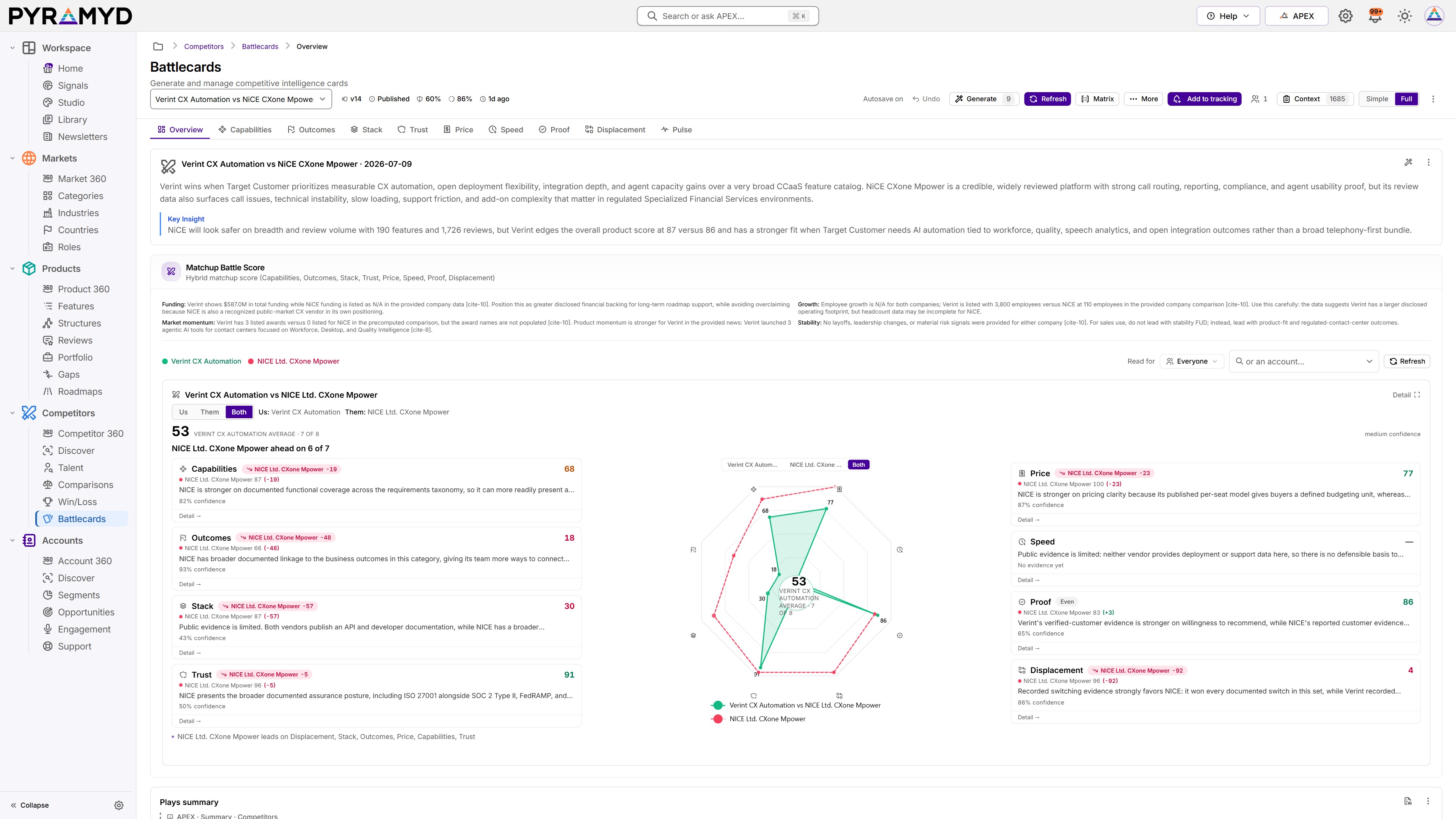
The executive summary, the plays (landmines, objection handling, and discovery questions), the buyer personas, and the evidence behind the card
Capabilities
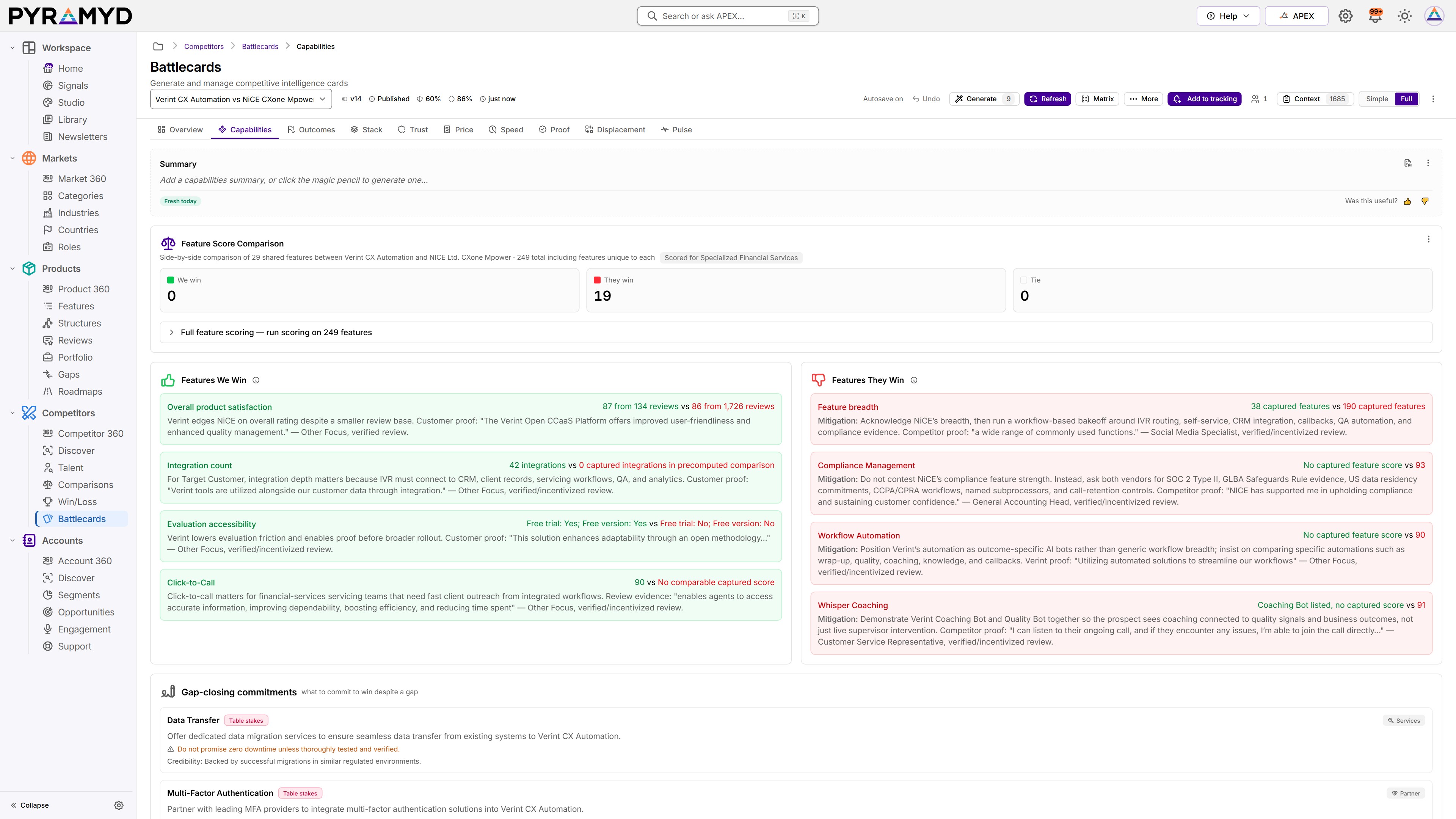
The feature matrix and a feature battleground, scored capability by capability
Outcomes
Vertical fit and use-case fit
Stack
How the two products' integrations compare
Trust
Compliance and certifications, and answers to fear, uncertainty, and doubt
Price
The value argument and the deal terms
Speed
How implementation goes, and the vendor's quality
Proof
Each side's strengths and weaknesses
Displacement
Switching signals, the rival's signals, and its customers
Pulse
Live news, signals, and hiring for the rival
The emailed copies are the shareable view: they leave out the card's sources, its Battle Score, the buyer personas, and the integration comparison. Win/loss and deal terms come from your own deals, so a card bought as a guest has none.
It tells you what it cannot claim
Where the evidence is thin, the card says so instead of filling the gap. A real generated card in this matchup returned “avoid review-based superiority claims — neither product has review or score data in the supplied evidence” and “do not claim vertical or regional advantage; the supplied evidence contains no industry-fit comparison.” A rep who repeats an unsupported claim loses the room, so the card refuses to hand them one.
In the app · Competitors
Battlecards, as it looks today
The process
What happens between checkout and the card.
Assembled from the graph, and rebuilt when you ask.
Pick the matchup: your product and the rival you sell against, both from the Product Graph. Add buyer context, if you have it.
It draws on the Product Graph: over 2.4 million reviews, over 190,000 standard features, 3.8 million vendor feature rows, and more than 2,000 signal sources. From it, PYRAMYD pulls the evidence on both products.
An AI model then writes the card, tab by tab, from that evidence, and every claim names the source it came from.
Both products are scored from 0 to 100 on the card's eight dimensions, from Capabilities to Displacement, computed in code. Where there is no evidence, there is no score.
From the rival's Competitor 360, the card adds the moves it is likely to make next, each with a probability, and plays for your next call: landmines to set, objections to handle, and questions to ask.
Your battlecard arrives by email: a link, a PDF, and a deck with one slide per tab.
Narrated walkthrough, about 71 seconds. Turn on narration to hear it; the captions on the board carry the same words.
Read the six steps
- Pick the matchup. Pick the matchup: your product and the rival you sell against, both from the Product Graph. Add buyer context, if you have it.
- Read the evidence. It draws on the Product Graph: over 2.4 million reviews, over 190,000 standard features, 3.8 million vendor feature rows, and more than 2,000 signal sources. From it, PYRAMYD pulls the evidence on both products.
- Write it, tab by tab. An AI model then writes the card, tab by tab, from that evidence, and every claim names the source it came from.
- Score the matchup. Both products are scored from 0 to 100 on the card's eight dimensions, from Capabilities to Displacement, computed in code. Where there is no evidence, there is no score.
- Predict and play. From the rival's Competitor 360, the card adds the moves it is likely to make next, each with a probability, and plays for your next call: landmines to set, objections to handle, and questions to ask.
- Delivered to you. Your battlecard arrives by email: a link, a PDF, and a deck with one slide per tab.
How it works
From checkout to battle-ready, emailed when it is ready
Name the matchup
Your product and theirs: both sides come from the graph, so there is nothing to upload. Then tune it to the deal you are actually in: the buyer personas it should speak to, the customer's industry and location, and the tone. The preview re-writes itself as you change them.
Check out as a guest
$90, an email address, and nothing else. No account, no sales call, no platform commitment. The email lets you keep the card in a free reports account, if you want one.
It arrives by email
We email it when it is ready: a view link, a PDF, and a PowerPoint of its ten tabs, from Overview to Pulse, and a link to keep it in a free reports account.
Keep it true
Rebuild the card whenever you need it, paid with tokens within the limits you set, so it is current before your next call.
Two ways in
Keep what you buy, or bring your team.
For the reports you buy
A free reports account
Every battlecard and 360 report you buy, and every one a colleague shares with you, in one place. Rebuild a battlecard whenever you need it, paid with tokens. No subscription.
For your team
Workspace and a hub
Workspace (Home, Signals, Studio, Library, Newsletters, and APEX) comes with every plan. Starter adds one hub you choose, and Growth all four, so your team opens the 360s in the app and refreshes them whenever you ask.
Need the whole picture?
360 reports: one company, product, or market.
A battlecard answers one matchup. A 360 report scores a whole market, product, competitor, or account on eight dimensions, paid once the same way as each one goes on sale.
Coming soon
Market 360
Is this market worth going after, and how much room is left in it?
What it covers: Market 360Coming soon
Product 360
How good is this product, measured against its category?
What it covers: Product 360Coming soon
Competitor 360
How strong is this competitor, and where can you beat it?
What it covers: Competitor 360Coming soon
Account 360
What is going on inside this account?
What it covers: Account 360
Battlecards built from your product, the competitor's, and the evidence between them: reviews, signals, pricing, and feature scores, not a template filled in by an intern. Each card says where its evidence is thin.